




601 N Craycroft Rd
Tucson, AZ 85711

Stretching and Strengthening: Why You Need Both and How They Work Together
Most people know they should stretch more. Fewer realize that stretching alone is only half the equation. Without the strength to back it up, flexibility gains fade quickly, and the underlying problem stays put.
Understanding what each one actually does, and why your body needs both, helps you make better decisions about your own care and recovery.

What Stretching Actually Does
Stretching lengthens muscle tissue and improves the range of motion around a joint. When a muscle is chronically tight, it pulls on the structures attached to it, including tendons, joints, and surrounding muscles. That tension is a common driver of back pain, neck pain, and tension headaches.
Regular stretching reduces that pull, improves circulation to the tissue, and gives the joints more room to move the way they are designed to. It also tends to reduce the perception of pain in tight areas, even before anything has structurally changed.
What stretching does not do is fix the reason a muscle became tight in the first place. If a muscle is tight because it is overworked and compensating for weakness somewhere else, stretching it brings temporary relief. The tightness returns because the underlying imbalance is still there.
What Strengthening Actually Does
Strengthening builds the capacity of a muscle to generate force and sustain effort over time. In a clinical context, targeted strengthening does something more specific: it corrects the imbalances that cause joints to load unevenly and muscles to compensate for one another.
Weak deep spinal muscles, for example, force the larger superficial muscles to take on stability work they are not designed for. That is one of the most consistent contributors to chronic lower back pain. Strengthening the right muscles takes that load off.
Strengthening also protects joints. The muscles surrounding a joint act as its active support system. When those muscles are strong and balanced, the joint is less vulnerable to strain, wear, and injury.
Stretching
Improves flexibility and range of motion. Reduces tension and pain in tight tissue. Results are real but temporary without addressing the cause.
Strengthening
Corrects muscle imbalances and protects joints. Provides lasting structural support. Makes the gains from stretching stick over time.
Why Most People Default to One or the Other
People in pain reach for stretching first. It provides relief quickly and feels intuitive. Athletes and active people often default to strengthening because it is more familiar to them. Both groups tend to underinvest in whichever side they are not naturally drawn to.
The result is predictable. The person who only stretches stays flexible but deals with recurring pain because nothing is stabilizing the joints. The person who only strengthens builds strength through a restricted range of motion and is more prone to injury when pushed past that limit.
Neither approach is wrong. Both are incomplete on their own.
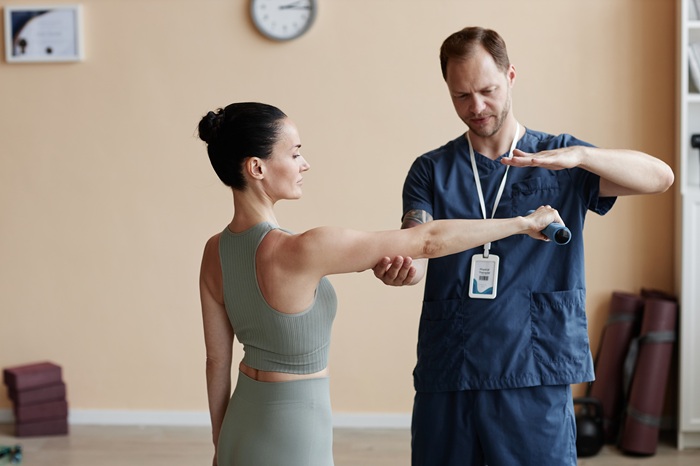
Where Chiropractic Fits Into This Picture
A chiropractic adjustment restores movement to joints that are restricted. That matters more than most people realize, because a restricted joint changes how the muscles around it behave. Muscles attached to a joint that is not moving properly become either overactive and tight or inhibited and weak, regardless of what the person is doing in the gym or in their stretching routine.
Getting the joint moving again resets the playing field. Stretching and strengthening then work the way they are supposed to, instead of fighting against a mechanical problem that has not been addressed.
This is why patients who have struggled with persistent pain often find that adding chiropractic care to their routine produces results that stretching or exercise alone never did. The missing piece was joint mobility, not effort.
Mobility first, then stability. Getting restricted joints moving before loading the surrounding muscles with strength work produces better outcomes and reduces the risk of reinforcing a compensatory pattern.
This is why rehabilitation exercises at this practice are always prescribed after an assessment of how the spine and joints are actually moving, not handed out as a generic program.
Common Conditions Where This Approach Makes a Real Difference
Stretching and strengthening, when applied correctly, are relevant to nearly every musculoskeletal complaint. A few of the most common ones we see in Tucson:
- Back pain. Usually a combination of tight hip flexors and hamstrings pulling on the pelvis, alongside weak deep spinal and core muscles failing to support the lumbar spine. Both sides need attention.
- Sciatica. Piriformis tightness and gluteal weakness are frequent contributors. Stretching the piriformis reduces nerve pressure; strengthening the glutes reduces recurrence.
- Neck pain. Upper trapezius and levator scapulae tightness are nearly universal in desk workers. Deep cervical flexor weakness is just as common and rarely addressed without targeted exercise.
- Shoulder pain. Rotator cuff imbalances and poor scapular control are often behind persistent shoulder complaints. Flexibility around the joint helps, but stability work is what resolves it.
- Knee pain. Quad dominance, tight IT bands, and weak hip abductors frequently drive knee problems. The knee is often the victim, not the source.
- Plantar fasciitis. Calf tightness and limited ankle mobility put excessive load on the plantar fascia. Calf stretching combined with foot and ankle strengthening is a core part of recovery.

How to Know What You Actually Need
Generic exercise advice has a ceiling. What works well for one person can aggravate another, depending on what joints are restricted, which muscles are compensating, and what the actual pain generator is.
An assessment tells you which muscles are short and overactive, which are long and underactive, and where the movement restrictions in your spine and joints are. From there, a targeted program is straightforward. Without that baseline, most people are guessing.
If you have been stretching the same spots for months without lasting improvement, or if you have been exercising consistently but still dealing with recurring pain, it is worth finding out why the approach is not working rather than simply doing more of it.
Dr. Heaton will assess your movement patterns, identify what is contributing to your symptoms, and build a plan around what you specifically need, not a one-size-fits-all program.
Arizona Chiropractic & Spine Rehabilitation is at 601 N Craycroft Rd, Tucson, AZ 85711.
Call (520) 600-3300 or request an appointment online.
At Arizona Chiropractic in Tucson, our mission is not only to help you recover from pain, but also to educate and empower you with the tools to maintain long-term health and wellness.
Quick links
Office Hours
Monday | 8AM - 6PM
Tuesday | 8AM - 6PM
Wednesday | 8AM - 6PM
Thursday | 8AM - 6PM
Friday | 9AM - 1PM
Saturday & Sunday | Closed
Get In Touch
601 N Craycroft Rd
Tucson, AZ 85711
Copyright © 2026 Arizona Chiropractic & Spine Rehabilitation