




601 N Craycroft Rd
Tucson, AZ 85711

Long-Term Benefits of Spinal Decompression for Auto Accident Victims
Most people think about pain relief when they think about treatment after a car accident. But pain relief is only part of the picture. The more important question is whether the underlying injury actually heals, or whether it quietly progresses into a long-term problem.
For injuries involving the spinal discs and compressed nerves, spinal decompression after an accident in Tucson, AZ is one of the most effective tools available. Not just for short-term symptom relief, but for genuine structural recovery that holds over time.
What Happens to Your Discs in a Car Accident
The intervertebral discs are the shock-absorbing pads between each vertebra. They are made of a tough outer ring called the annulus fibrosus and a gel-like center called the nucleus pulposus.
During a collision, the spine is subjected to rapid, violent forces that it was not designed to withstand. The disc can be compressed, shifted, or torn. The most common outcomes are a bulging disc, where the outer ring deforms outward under pressure, and a herniated disc, where the inner material pushes through a crack in the outer ring.
Both can press against nearby nerves, causing pain, numbness, tingling, or weakness that radiates far from the original injury site. A lower back disc injury can produce leg pain. A cervical disc injury can send symptoms down the arm into the hand.
These injuries do not always produce immediate severe pain. They can develop progressively as inflammation builds in the days after the accident, which is one reason they are so often missed in the early aftermath of a crash.
How Spinal Decompression Works
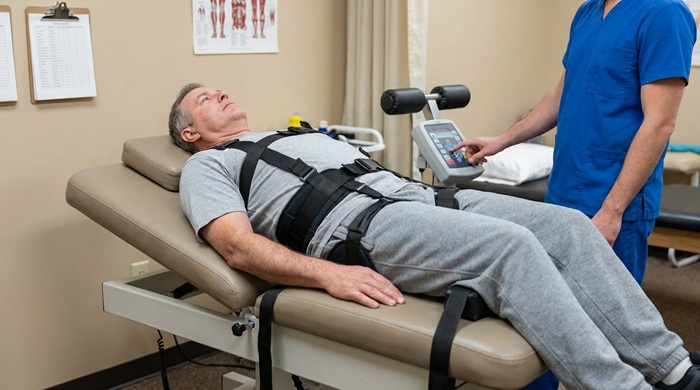
Spinal decompression therapy uses a motorized traction table to gently and precisely stretch the spine in a controlled, rhythmic pattern.
This stretching creates a negative pressure inside the affected disc space. That pressure drop does two important things.
First, it encourages bulging or herniated disc material to retract back toward the center of the disc, reducing the mechanical pressure on nearby nerves.
Second, it creates a pumping effect that draws in oxygen, water, and nutrients that compressed discs are starved of. Discs have no direct blood supply and depend entirely on this diffusion process to stay healthy. Decompression restores it.
The result is not just less pain in the short term. It is a disc that is actually healing rather than slowly deteriorating.

The Long-Term Benefits That Matter Most
Spinal decompression is often discussed in terms of pain reduction. That is real and usually significant. But for auto accident victims specifically, the long-term benefits go well beyond symptom management.
- Actual disc healing, not just pain suppression. Most pain management approaches, including medication and passive rest, reduce what you feel without addressing the structural damage. Decompression promotes rehydration and repair of the disc itself. Patients who complete a full course of care often show measurable improvement in disc height and reduced herniation on follow-up imaging.
- Prevention of disc degeneration. An injured disc that is not properly treated loses water content and structural integrity over time. This is how a collision injury at 35 becomes chronic degenerative disc disease at 45. Decompression interrupts that process by restoring the disc's nutritional environment and reducing the compressive forces accelerating breakdown.
- Nerve recovery. Compressed nerves can recover remarkably well once the source of pressure is removed and tissue inflammation subsides. Patients who have been dealing with radiating back pain, sciatica, or hand numbness often see those symptoms resolve or significantly reduce as the disc retracts off the affected nerve root.
- Reduced risk of surgery. For patients who have been told surgery may be necessary, decompression is frequently an effective conservative alternative. Resolving the disc problem non-invasively avoids surgical risks, recovery time, and the complications that can follow spinal procedures.
- Restored range of motion. Disc compression and nerve irritation create protective muscle guarding that limits how the spine moves. As disc pressure normalizes, that guarding releases and range of motion returns. Patients report being able to move, sleep, and sit comfortably in ways they could not during the acute phase of their injury.
- Better outcomes from other treatments. Decompression works best as part of a coordinated care plan. When disc pressure is reduced, chiropractic adjustments work more effectively on the surrounding joints, and rehabilitation exercises can begin building the strength and stability needed to protect the recovered disc.
Who Is a Good Candidate After a Car Accident
Spinal decompression is not appropriate for every patient or every type of injury. Dr. Heaton evaluates each patient thoroughly before recommending it.
It is particularly well-suited for accident victims who are experiencing any of the following:
- Radiating pain, numbness, or tingling down the arm or leg
- Diagnosed disc herniation or bulging disc from accident imaging
- Persistent neck pain or lower back pain that has not responded to basic care
- Sciatica that developed in the weeks following the collision
- Disc-related symptoms in patients who want to avoid surgical intervention
It is generally not recommended for patients with fractures, severe osteoporosis, spinal instability, or certain other conditions. A proper evaluation makes that determination clearly.
Discs respond best to decompression in the weeks and months following an injury, before significant degeneration has taken hold.
Waiting years to address a disc injury makes recovery slower and less complete. The structural window for optimal healing is real, and it closes gradually the longer the problem goes untreated.

What a Course of Treatment Looks Like
A typical decompression session lasts 30 to 45 minutes. The table moves in a slow, controlled pattern that most patients find comfortable, sometimes even relaxing.
The number of sessions needed depends on the severity of the disc injury, how long it has been present, and how the individual responds to treatment. Most protocols involve multiple sessions over several weeks.
Progress is evaluated regularly. If the response is good, treatment continues. Dr. Heaton will always be direct about what is working and what adjustments might improve outcomes.
Decompression is often combined with infrared cold laser therapy to enhance tissue healing at the cellular level, and with electrical muscle stimulation to reduce surrounding muscle spasm and improve comfort during and after sessions.
What the Research Says
Non-surgical spinal decompression is supported by clinical evidence for disc-related conditions including herniated discs, degenerative disc disease, and radiculopathy (nerve root pain).
The National Center for Complementary and Integrative Health recognizes non-drug, hands-on approaches to spinal pain as evidence-supported options recommended by the American College of Physicians as first-line treatment for both acute and chronic back pain. Their guidance consistently points to conservative care as the appropriate starting point before surgical or pharmaceutical intervention.
For auto accident victims specifically, the combination of disc injury with nerve irritation makes the non-surgical decompression approach particularly relevant. Addressing the structural source of the problem early produces better long-term outcomes than waiting for symptoms to worsen or defaulting to medication to manage them.
Ready to Find Out If Decompression Is Right for You?
If you were in a car accident and are dealing with back pain, neck pain, sciatica, or radiating symptoms, a chiropractic evaluation at Arizona Chiropractic & Spine Rehabilitation will tell you exactly what is going on and whether spinal decompression is appropriate for your injury.
601 N Craycroft Rd, Tucson, AZ 85711.
Call (520) 600-3300 or request an appointment online.
At Arizona Chiropractic in Tucson, our mission is not only to help you recover from pain, but also to educate and empower you with the tools to maintain long-term health and wellness.
Quick links
Office Hours
Monday | 8AM - 6PM
Tuesday | 8AM - 6PM
Wednesday | 8AM - 6PM
Thursday | 8AM - 6PM
Friday | 9AM - 1PM
Saturday & Sunday | Closed
Get In Touch
601 N Craycroft Rd
Tucson, AZ 85711
Copyright © 2026 Arizona Chiropractic & Spine Rehabilitation